The trouble with writing down everything is that the speaker does not wait while you finish. You catch one sentence on paper and lose the next two in the air. By the time a decision is made, your notes may contain the opening suggestion but not the change of plan.
Good listening notes are deliberately incomplete. They preserve the information that helps you reconstruct meaning: people, goals, obstacles, contrasts and outcomes. Your task is to understand a conversation, not produce minutes for a committee.
Give each speaker a small space
When several people are involved, separate their positions. Use initials or brief labels rather than full names if that helps. A line such as “M: likes plan / cost?” captures both support and a reservation. Do not record a negative word without recording whose view it belongs to.
It is possible to understand every individual sentence and still answer a question incorrectly because you assign one person’s concern to someone else. Speaker labels are a cheap way to prevent an expensive confusion.
Mark changes more clearly than background details
Words such as “but,” “instead,” “unless” and “actually” can change the direction of a conversation. Treat them as signals to update the story in your notes. If Friday is proposed and then rejected, cross it out. Otherwise, the earlier information can look just as important as the final arrangement.
Use a notation system that is obvious to you. Arrows, a question mark and a crossed-out option are enough. An elaborate shorthand system is not useful if you spend the recording remembering how to use it.
Try this original meaning drill
Maya: We could hold the volunteer meeting on Friday evening.
Jon: I can do Friday, but the community room is booked. Saturday morning is still available.
Maya: Saturday works for me if we finish before eleven.
Jon: Then let’s book it for nine and keep the agenda short.
Question: What have they agreed to do? The supported answer is to meet on Saturday at nine, with an early finish. Friday is background, not the decision. “Maya cannot attend on Saturday” would ignore the condition attached to her agreement.
This written mini-drill isolates the reasoning. It is not an audio test or an official item. To practise the listening part, have a partner read an unfamiliar exchange once, or use a fresh recording in a practice resource.
Separate stated facts from reasonable guesses
A conversation can make a possibility sound likely without confirming it. If someone says a manager “may approve” a request, your notes should not say “approved.” Similarly, a complaint about cost does not necessarily mean the speaker rejects the proposal altogether.
During answer review, identify the level of certainty. Is the idea confirmed, suggested, conditional or contradicted? This small classification helps when two options are similar but one makes a stronger claim than the recording supports.
Review audio in two different modes
Use uninterrupted listening for a timed attempt. Afterwards, use short replays for study when your resource allows them. On the replay, find the exact point where your interpretation changed or should have changed. If a transcript is available, consult it after listening—not before the first attempt.
Keep a list of phrases you genuinely failed to hear. Sometimes the problem is unfamiliar vocabulary; sometimes familiar words sound different when linked together. Read the phrase aloud and compare it with the recording. Do not add fifty unrelated vocabulary words because you missed one reduced phrase.
A goal for your next session
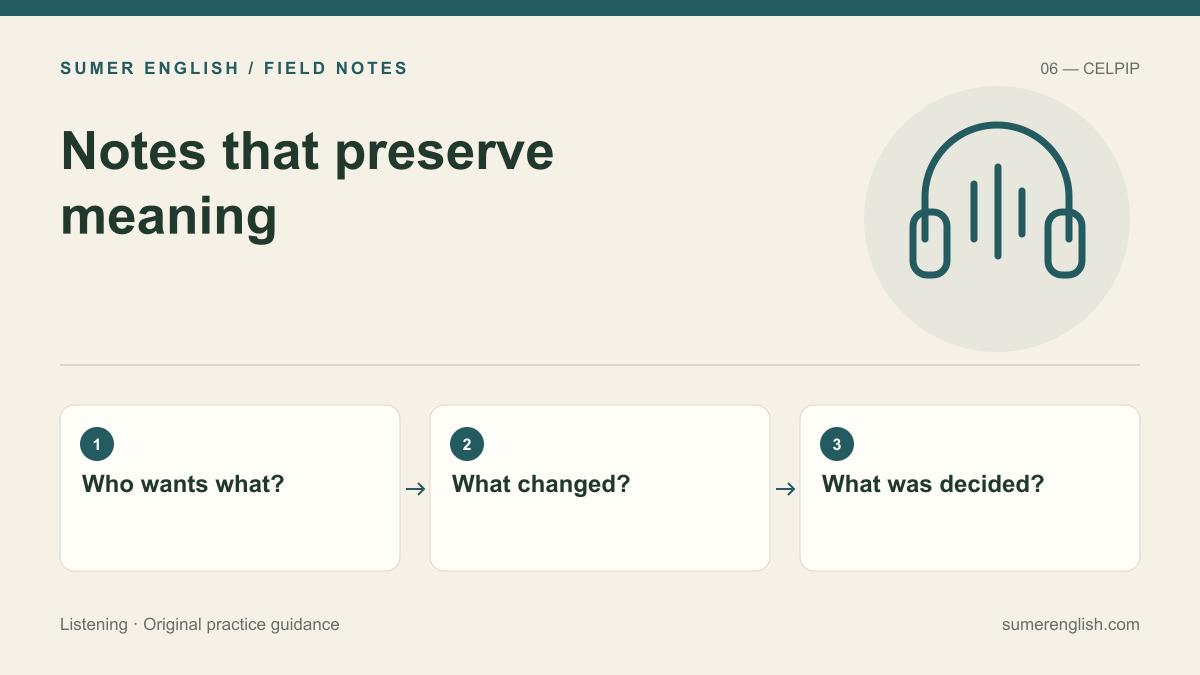
Choose one Listening practice test and track only three things: the original problem, each speaker’s position and the outcome. After reviewing the answers, check whether your notes preserved those relationships.
If they did, try slightly fewer notes next time. If they did not, add the missing category. Better notes are not necessarily shorter; they are notes that help you answer the question you actually heard.
Sources & editorial notes
Official details checked on . Verify changing prices, policies and requirements with the relevant organisation.
Examples and practice advice are original Sumer English material, not official test questions or rated responses. Sumer English is independent of the CELPIP test provider. How we prepare these guides.