You can spend an entire evening preparing for CELPIP without learning very much. Open a practice test, finish it, look at the score, and start another one. It feels productive because the question counter keeps moving. The problem is that the same mistakes often come along for the ride.
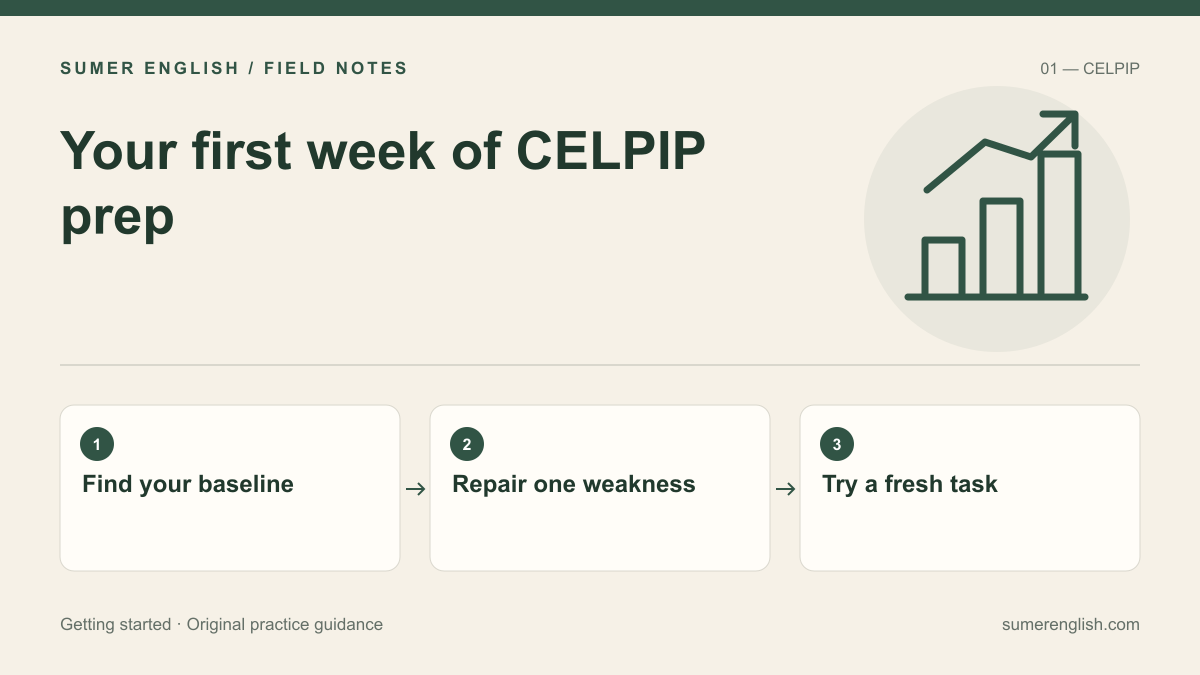
A better starting point is a small plan: find out what the test asks you to do, identify where your performance breaks down, and give your next practice session one specific job. You do not need a shelf of textbooks to begin.
First, make sure you are preparing for the right test
CELPIP-General covers Listening, Reading, Writing and Speaking. CELPIP-General LS covers Listening and Speaking only. Confirm the version accepted by the organisation requesting your results before booking. These are different products, not an easier and harder version of the same application requirement.
The official format page is the right place to check the current task structure. In General, Writing includes an email and a survey response; Speaking uses eight tasks. Learning what each task wants removes unnecessary surprises. It does not replace learning the language.
Give yourself an honest starting point
Try unfamiliar material under the stated time limits. Use a keyboard for writing and actually record your speaking. Thinking of an answer silently is much easier than producing it out loud while the clock is running.
Keep the conditions reasonably consistent. If you pause a listening recording, consult a dictionary during reading, or spend twice the allowed time on writing, label that session as study rather than a test. Both activities are useful; they answer different questions.
Afterwards, write one sentence about each skill. Be concrete: “I lose track of who supports which proposal” is more useful than “My listening is bad.” “My email answers two of the three instructions” gives you a clear repair job. An estimated practice score is a clue, not an official result.
Use a three-part study session
For a 45-minute session, try 15 minutes of focused work, 20 minutes of review and 10 minutes of another attempt. Those numbers are a study suggestion, not CELPIP timing rules. The important part is reserving enough time to understand the first attempt.
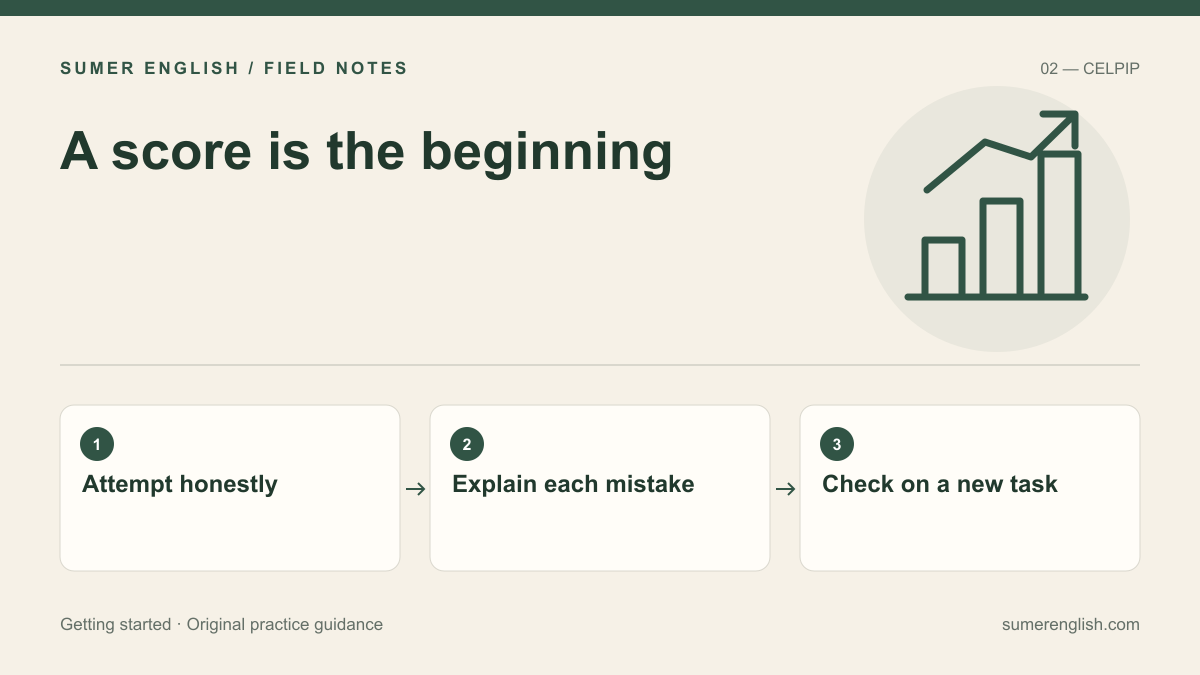
- Attempt: complete one task without checking the answer.
- Review: find the exact sentence, missing detail or spoken hesitation that caused trouble.
- Transfer: use the same improvement on a different prompt.
Suppose you chose a Reading answer because it repeated a word from the passage. During review, locate the sentence that actually proves the answer. Then explain why your choice is wrong. Your next task is to demand that same evidence before selecting an option. This changes a habit; merely memorising the correct letter does not.
Keep a mistake log you will actually read
A notebook with three columns is enough: what happened, why it happened, and what to try next. Do not transcribe every question. Record recurring patterns, such as missing a contrast word, writing an unclear request, or giving an opinion without an example.
At the start of the next session, read the last three entries. Choose one. If you try to fix vocabulary, grammar, timing and confidence simultaneously, it becomes difficult to know what helped.
Balance skill practice with full rehearsals
A full rehearsal checks stamina and pacing. Short drills let you repair a weakness without waiting two hours to reach it. Use both. Early in preparation, targeted drills usually make it easier to see what needs work; closer to test day, a realistic rehearsal can expose problems that only appear when you are tired.
The official preparation site offers sample material. Sumer English also provides independent CELPIP-style practice through CELPIP Test Online. Tests 1 and 2 in each skill are free after sign-in; later tests require Pro. Neither our practice questions nor our estimates are official test items or official scores.
What should you do today?
Choose one unfamiliar task, finish it honestly, and spend at least as much attention on the review as on the score. Before stopping, write down tomorrow’s task in a sentence: “I will practise explaining two reasons for one choice.” A small, repeatable routine is easier to maintain than a heroic weekend followed by a week of avoidance.
You cannot schedule a guaranteed score. You can schedule useful work—and make sure each session leaves you with something more specific than “do more practice.”
Sources & editorial notes
Official details checked on . Verify changing prices, policies and requirements with the relevant organisation.
Examples and practice advice are original Sumer English material, not official test questions or rated responses. Sumer English is independent of the CELPIP test provider. How we prepare these guides.