A Reading option can contain the exact words you remember from a passage and still be wrong. It might reverse the relationship, remove a condition or attach the right detail to the wrong person. That is why hunting for matching words is only a first step.
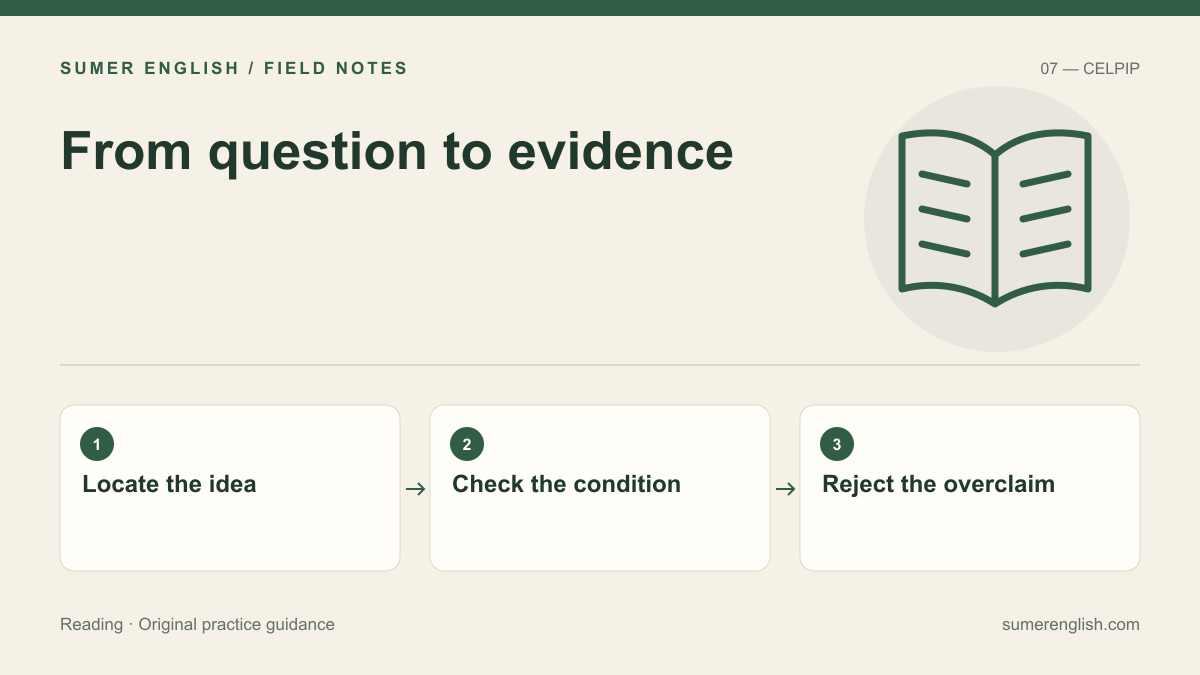
A more reliable habit is to ask: which part of the text proves this answer? If you cannot point to it, you may be choosing something plausible rather than something supported.
Get the shape of the text first
Notice what you are reading. An email has a sender, a recipient and a purpose. An information page may organise facts by topic. A discussion of viewpoints may move between positions. This quick map helps you return to the right place instead of rereading from the beginning every time.
Skimming is not pretending to read quickly. It is reading for structure. Look for paragraph roles: the problem, an explanation, an alternative, an objection or a conclusion. You do not need to understand every unfamiliar word to notice those roles.
Translate the question into a search target
If the question asks why a schedule changed, look for the reason, not just the new time. If it asks what a writer recommends, distinguish that recommendation from an option the writer merely mentions.
Then read the relevant sentence together with its neighbours. A condition in the previous sentence can limit a claim in the next. A contrast word may tell you that the writer is about to reject the very idea you located.
An original evidence exercise
The neighbourhood centre will extend its evening hours during the winter. The extra hours will apply to the study room only; the sports facilities will continue to close at their usual time. The centre will review attendance in March before deciding whether to keep the arrangement.
Which statement is supported? A: All facilities will stay open later permanently. B: The study room will have later hours during winter. C: The centre has already decided to continue the change after March.
B is supported. A changes “study room only” into “all facilities” and turns a limited arrangement into a permanent one. C turns a future review into a completed decision. The distractors do not need difficult vocabulary to be wrong.
Watch words that change the size of a claim
Pay attention to “some,” “all,” “usually,” “only,” “may” and “must.” These words can carry more decision-making weight than a long descriptive phrase. An option that says “always” needs stronger support than one that says “sometimes.”
Do not automatically reject strong language, though. If the text genuinely says everyone must register, the correct answer may also be absolute. The rule is to match the strength of the statement to the evidence, not to follow a shortcut such as “never choose always.”
Deal with an unknown word in context
First decide whether the word is necessary for the question. If it is, look at its grammatical role and nearby examples or contrasts. Can you tell whether it refers to a person, an action, a positive result or a problem? A partial understanding may be enough to distinguish the options.
After the timed session, look up important recurring words and write a new sentence with each. During study, a dictionary is useful. During a readiness check, constant dictionary use changes what you are measuring.
Build a review habit around the closest wrong answer
For each mistake, explain why your chosen option almost worked. Was the fact in the passage but unrelated to the question? Did you miss an exception? Was your answer based on real-world knowledge rather than the text?
Use a fresh Reading practice section to test that insight. Your goal is not simply to read faster. It is to spend less time choosing between options once you know what evidence would settle the choice.
Sources & editorial notes
Official details checked on . Verify changing prices, policies and requirements with the relevant organisation.
Examples and practice advice are original Sumer English material, not official test questions or rated responses. Sumer English is independent of the CELPIP test provider. How we prepare these guides.