A survey response often becomes difficult at the planning stage. You can see advantages on both sides, so you spend several minutes trying to choose the objectively correct option. For practice purposes, that is usually the wrong problem to solve.
Choose the option you can explain clearly with relevant support. You are demonstrating how you communicate a position, not proving that your preference is the only sensible one.
Know the task, then make a small plan
The official 2026 CELPIP overview describes Task 2 as a survey choice with a 150–200-word response and 26 minutes. Follow the exact instructions on the test. Unlike an email, this response does not need a greeting and sign-off.
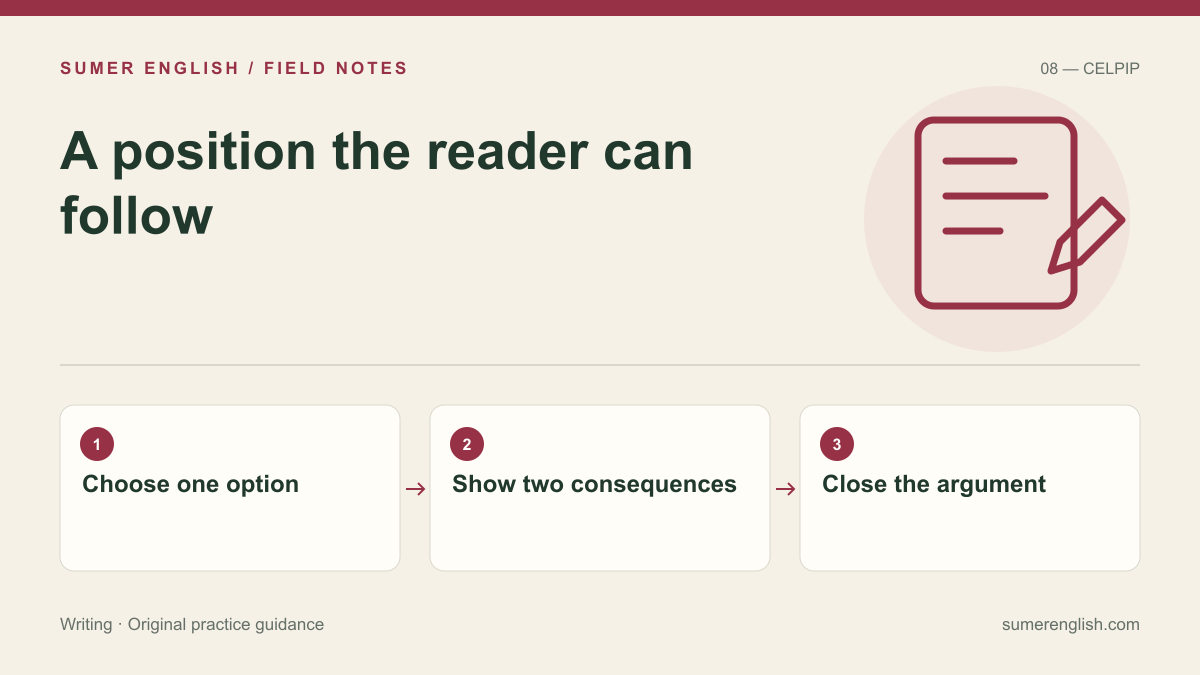
Before drafting, write your choice and two reasons. Add one concrete consequence under each reason. If both reasons lead to the same explanation, combine them and find a genuinely different second point.
An original practice prompt
Practice scenario—not an official question: A community centre has funding for one improvement. Option A is a larger fitness room. Option B is an evening study room with reliable internet access. Choose the improvement you prefer and explain your reasons.
Sample survey response
I would support opening an evening study room rather than expanding the fitness room. Although both improvements would benefit residents, a quiet place to work would meet a need that is currently difficult to address.
First, many people in our neighbourhood share small homes with relatives or roommates. Studying at the kitchen table is not always practical, especially when other family members are cooking or relaxing. A study room that stays open in the evening would give students and working adults a dependable place to concentrate after their daytime commitments.
Second, reliable internet access would make the space useful for more than homework. Residents could complete online training, prepare job applications or attend a remote class. Providing a few bookable desks would allow the centre to serve these different needs without requiring a separate programme for each activity.
A larger fitness room would be welcome, but residents already have several exercise options nearby. For that reason, I believe the study room would fill the more significant gap and make better use of the available funding.
This original sample has not been rated by an official examiner. It is included to show organisation and development, not to attach an unverified score to a piece of writing.
Look at the work each paragraph does
The opening makes the choice clear. The next paragraph describes a specific barrier: shared living space. The following paragraph adds a different benefit: access to online tasks. The conclusion acknowledges the alternative without abandoning the original position.
Notice that “useful” is explained through activities. Homework, training and job applications make the benefit easier to understand. You do not need an invented statistic such as “ninety percent of residents need this room.” A plausible, clearly labelled scenario is enough for the argument.
Avoid three common detours
Listing instead of developing: “It is convenient, affordable, helpful and modern” names benefits but explains none. Choose fewer and show how they would work.
Arguing against yourself for too long: acknowledging a reasonable alternative can make the response balanced. Giving that alternative more space than your chosen option can make your position unclear.
Using a memorised introduction: a paragraph about how society is changing rarely helps explain whether a community centre needs a study room. Start close to the actual decision.
Practise the other side
Now argue for the fitness room. Perhaps the existing space is inaccessible or too crowded. You will need different details, not the same response with the option names reversed. This is a useful way to check whether you are reasoning from the scenario or relying on a fixed script.
Finish with an editing pass for task coverage, paragraph focus and sentence clarity. Then use a fresh Writing prompt. A flexible method should survive a new topic; a memorised answer usually does not.
Sources & editorial notes
Official details checked on . Verify changing prices, policies and requirements with the relevant organisation.
Examples and practice advice are original Sumer English material, not official test questions or rated responses. Sumer English is independent of the CELPIP test provider. How we prepare these guides.