An effective CELPIP email is not a business letter wearing a costume. It is a message someone could read once and act on. If the recipient has to guess what happened or what you want, adding “I sincerely hope this correspondence finds you well” will not solve the problem.
The official 2026 overview gives Writing Task 1 a 150–200-word target and 27 minutes. Always follow the instructions and timer you are given. The planning method below is our practice advice, not an official scoring formula.
Read the situation before choosing your tone
Identify the recipient, your relationship, and the requested action. An email to a building manager usually needs polite, direct language. That does not mean every sentence must sound ceremonial. “Could you let me know when the repair can be completed?” is both natural and respectful.
Turn each instruction into a short note. Do this before writing your opening. It is easier to notice a missing point in a three-line plan than in a paragraph you have already spent ten minutes polishing.
An original practice prompt
Practice scenario—not an official test question: Your apartment building’s shared laundry room has had recurring problems. Write to the building manager. Describe the problem, explain how it affects residents, and suggest a practical solution.
Sample email
Dear Ms. Patel,
I am writing about the washing machines in the ground-floor laundry room. Two of the four machines have been out of service since last Thursday, and there is no notice explaining when they will be repaired.
This has made the room particularly crowded in the evenings. Yesterday, I waited almost an hour before a machine became available. Several residents work during the day, so using the laundry room at a quieter time is not always possible. One neighbour also mentioned that she had to take her children’s school clothes to a laundromat.
Could you arrange a repair visit and post an estimated completion date on the noticeboard? Until all four machines are working, a simple booking sheet might help residents plan their laundry and avoid unnecessary waiting. It would also be useful to have a contact number for reporting new faults.
I appreciate that repairs can take time, but a brief update would make the situation easier for everyone. Thank you for looking into this.
Kind regards,
Alex Chen
This is an original teaching example, not an officially rated answer. It illustrates choices you can reuse; it does not promise a particular CELPIP level.
Why the message works as an email
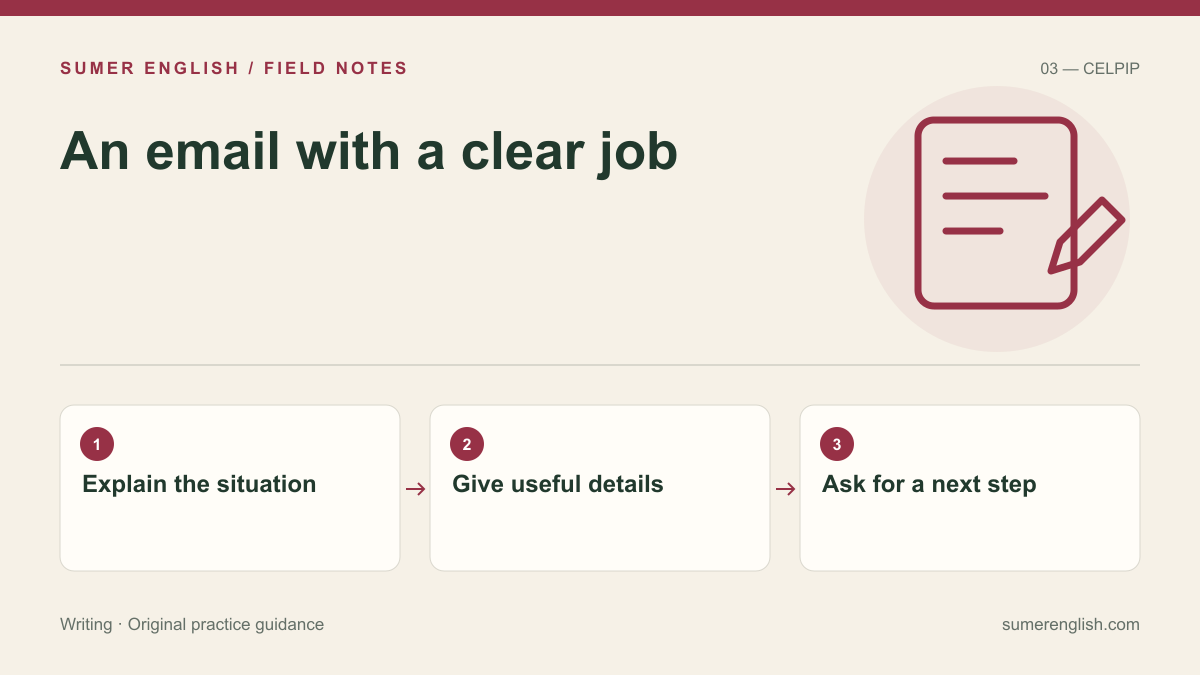
The first paragraph locates the problem: which machines, where they are, and how long they have been unavailable. The next paragraph explains the consequences rather than merely repeating that the situation is inconvenient. The request then gives the manager a manageable sequence: arrange repairs, communicate the date, and consider a temporary booking system.
Notice the vocabulary. “Out of service,” “estimated completion date” and “reporting new faults” are specific to the situation. They carry more useful meaning than unrelated advanced words. The tone is firm without becoming hostile.
Use the structure, not the story
If the prompt concerns a delayed delivery, the details must change. Who needs the item? What date was promised? What would be a reasonable solution? Copying the laundry-room story into another situation creates an answer that sounds prepared but does not do the task.
A flexible outline is enough: reason for writing, necessary details, impact, requested action and a suitable closing. Some prompts need a different order. An invitation may begin with the event and finish with arrangements; an apology may need responsibility before an explanation.
Your last editing pass
- Check every instruction against a specific sentence.
- Make the request easy to identify.
- Check dates, numbers and pronouns for contradictions.
- Remove repeated ideas before removing useful details.
- Read the opening and closing together: do they sound like the same relationship?
Then practise on a fresh Writing task. Give yourself a different recipient and problem. The real test of a structure is whether it helps you create a new, relevant message—not whether you can remember this one.
Sources & editorial notes
Official details checked on . Verify changing prices, policies and requirements with the relevant organisation.
Examples and practice advice are original Sumer English material, not official test questions or rated responses. Sumer English is independent of the CELPIP test provider. How we prepare these guides.