A diagram question can feel easy because the information is short. Then two options look almost right: one fits the budget, another fits the time, and neither fits both. The challenge is not always vocabulary. It is holding the conditions together.
The official Reading format includes a task that uses a diagram. The original exercise below practises the underlying skill with a simple table. It is not copied from an official test and does not reproduce the full test interface.
Read the need before searching the table
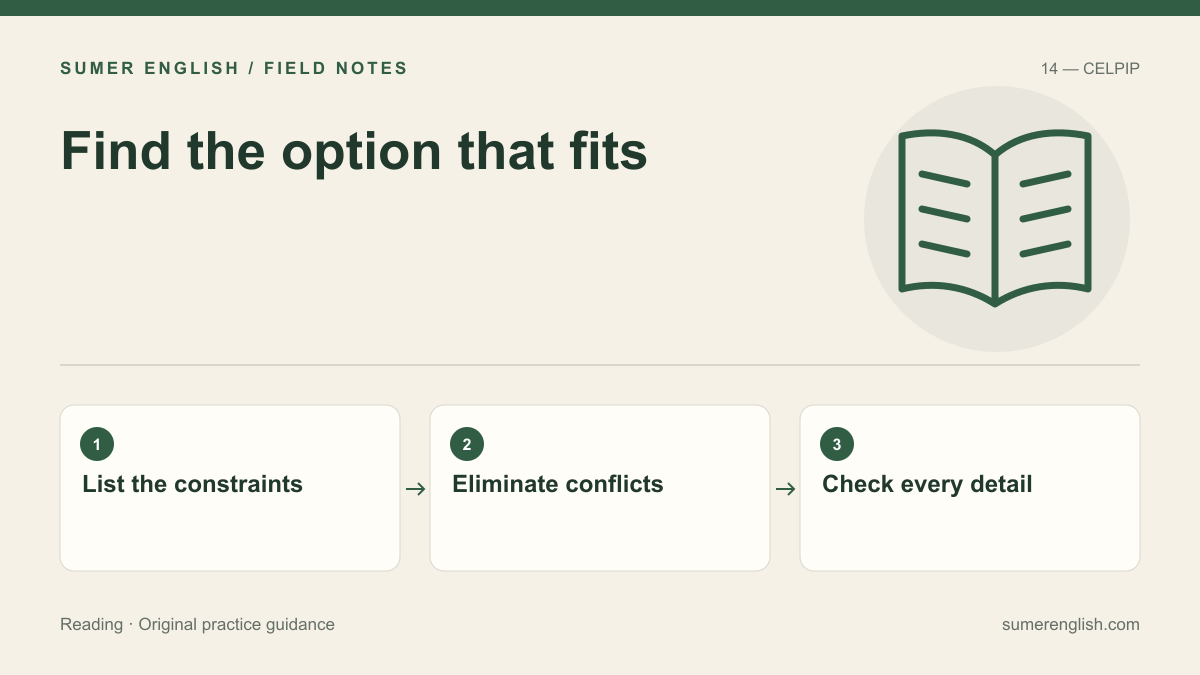
Write the conditions in a short list. Separate requirements from preferences. “Must finish before eight” rules an option out. “Would prefer a small group” may not, unless the task makes it essential. Treat words such as “only,” “at least” and “under” carefully.
Then compare the options systematically. Do not choose the first row with a familiar keyword and assume the other details will work.
An original practice schedule
| Class | Day and time | Level | Fee | Materials |
|---|---|---|---|---|
| Watercolour Basics | Tuesday, 18:00–19:30 | Beginner | $45 | Included |
| Evening Photography | Tuesday, 19:00–21:00 | Beginner | $40 | Bring a camera |
| Clay Workshop | Thursday, 18:30–20:00 | Beginner | $50 | Included |
| Portrait Drawing | Tuesday, 18:00–19:30 | Intermediate | $35 | Bring pencils |
Question 1: Leila wants a beginner class on Tuesday, can spend no more than $45, and needs to finish before 20:00. Which class fits?
Answer: Watercolour Basics. Photography is within budget and is for beginners, but ends too late. Portrait Drawing fits the day, time and price, but not the level. The clay class is on the wrong day and costs too much.
Question 2: Omar is available on Thursday and wants materials provided. Which option matches those two requirements?
Answer: Clay Workshop. Do not carry Leila’s budget limit into Omar’s question. Conditions belong to the person or task that states them.
Notice what the exercise is testing
Question 1 requires several checks, not a single lookup. The cheaper option is not automatically better. The first beginner option is not automatically correct. You need a complete match.
Question 2 adds a different trap: reusing a condition from the previous question. When several people or messages refer to one diagram, reset the requirement list for each. Reusing the table is efficient; reusing someone else’s restrictions is not.
Handle paraphrases carefully
A message might say “I have never tried this before” rather than “beginner.” It might say “I do not own any equipment” rather than “materials included.” Translate the meaning, then check whether the table actually answers that need.
Also notice when the diagram does not provide enough information. If a class lists materials as included, that does not tell you whether parking is free. Avoid importing assumptions from how community classes usually work.
Review by naming the failed condition
For each rejected option, name the precise reason it fails. “Wrong time” is less useful than “finishes at 21:00, but the learner must leave before 20:00.” This makes your reasoning visible and helps catch a careless comparison.
In a timed attempt, you will not write a paragraph for every option. Practise slowly first so that the checks become more efficient. Speed should come from a reliable sequence, not from skipping the inconvenient columns.
Try the method with fresh information
Create a second schedule with different dates, prices and restrictions, or use a new Reading practice task. Make sure you cannot answer from memory. The transferable skill is matching a person’s needs to the evidence in front of you.
Sources & editorial notes
Official details checked on . Verify changing prices, policies and requirements with the relevant organisation.
Examples and practice advice are original Sumer English material, not official test questions or rated responses. Sumer English is independent of the CELPIP test provider. How we prepare these guides.