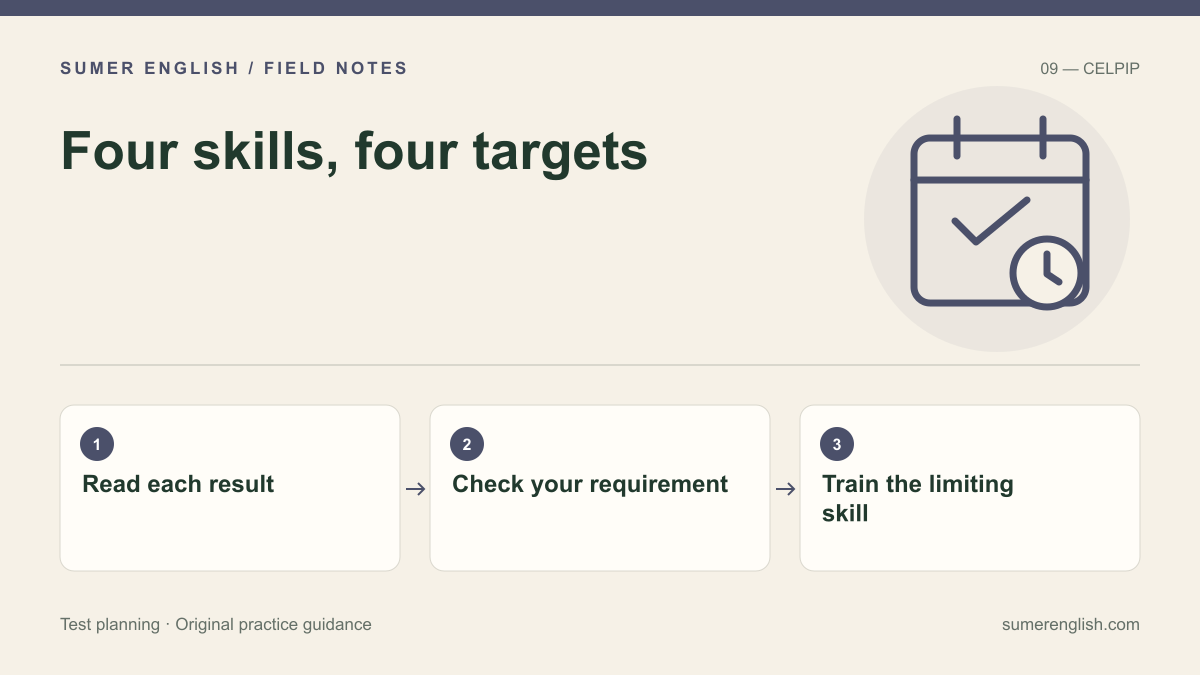
It is tempting to describe a result as “I got a nine” when one of the four numbers is a nine. That shorthand can hide the part that matters most for your next step. Read Listening, Reading, Writing and Speaking separately, then compare each with the requirement you actually need to meet.
A target should come from the organisation or programme receiving your results. This article explains score interpretation for study planning. It does not determine immigration eligibility or replace advice about an application.
How CELPIP levels correspond to CLB
The official CELPIP results chart shows a direct correspondence from CELPIP levels 3 through 12 to the same numbered Canadian Language Benchmark. For example, CELPIP 7 corresponds to CLB 7, and CELPIP 9 to CLB 9. Lower reporting categories need more care; use the official chart rather than extending that simple pattern to every possible entry.
For a common study target, the useful point is straightforward: if you need CLB 9 in each ability, you are working toward at least 9 in each relevant CELPIP component. A higher number in Listening does not by itself turn an 8 in Writing into a 9.
An invented score profile
| Skill | Example result | Example target | Study implication |
|---|---|---|---|
| Listening | 10 | 9 | Maintain under fresh timed conditions |
| Reading | 9 | 9 | Check consistency, not just one good attempt |
| Writing | 8 | 9 | Investigate task coverage and development |
| Speaking | 7 | 9 | Make this the main diagnostic priority |
These are fictional numbers. They illustrate allocation of effort, not an official assessment. The person in this example should not abandon Listening, but spending every evening on a comfortable Listening exercise would avoid the largest unresolved gap.
A score identifies a gap, not its cause
Two people with the same Writing result may need different work. One might leave an instruction unanswered. Another might provide relevant ideas in sentences that are hard to follow. The number alone cannot tell you which correction to make.
Look at actual responses. For Writing, compare the prompt with the completed message. For Speaking, listen for whether the explanation reaches its point. For Reading and Listening, examine the evidence behind missed answers. Turn the score into a question you can investigate.
Be cautious with raw-score calculators
A practice platform may estimate a level from the number of correct answers. Treat that as feedback within the resource, not a promise of an official result. Different materials vary in difficulty, and a familiar test is no longer an independent check of your performance.
If you track practice numbers, track conditions beside them: new or repeated material, timed or untimed, interrupted or uninterrupted. Without those notes, a rising chart can reflect a changing routine rather than stronger comprehension.
Build a target sheet with four lines
For each skill, record the required level, your most credible recent evidence and the next useful action. Keep the action small enough to complete. “Improve Speaking” is a wish. “Record three advice responses and check whether every suggestion has a reason” is a study task.
Revisit the sheet after a period of focused practice. Use new material and look for consistency across more than one session. One high practice score is encouraging, but a pattern gives you a better basis for deciding what to do next.
Where to check the official meaning
Use the official results and standards page for score categories, and the receiving organisation for its current acceptance rules. Use our practice library for the work between those two points: finding weaknesses, trying repairs and checking whether they transfer to unfamiliar tasks.
Sources & editorial notes
Official details checked on . Verify changing prices, policies and requirements with the relevant organisation.
Examples and practice advice are original Sumer English material, not official test questions or rated responses. Sumer English is independent of the CELPIP test provider. How we prepare these guides.