Imagine a friend asks how to settle into a new neighbourhood. “Be confident, stay positive and make friends” is kind, but it does not give them much to do tomorrow. The same problem appears in speaking practice: the response contains advice-shaped phrases without much practical advice.
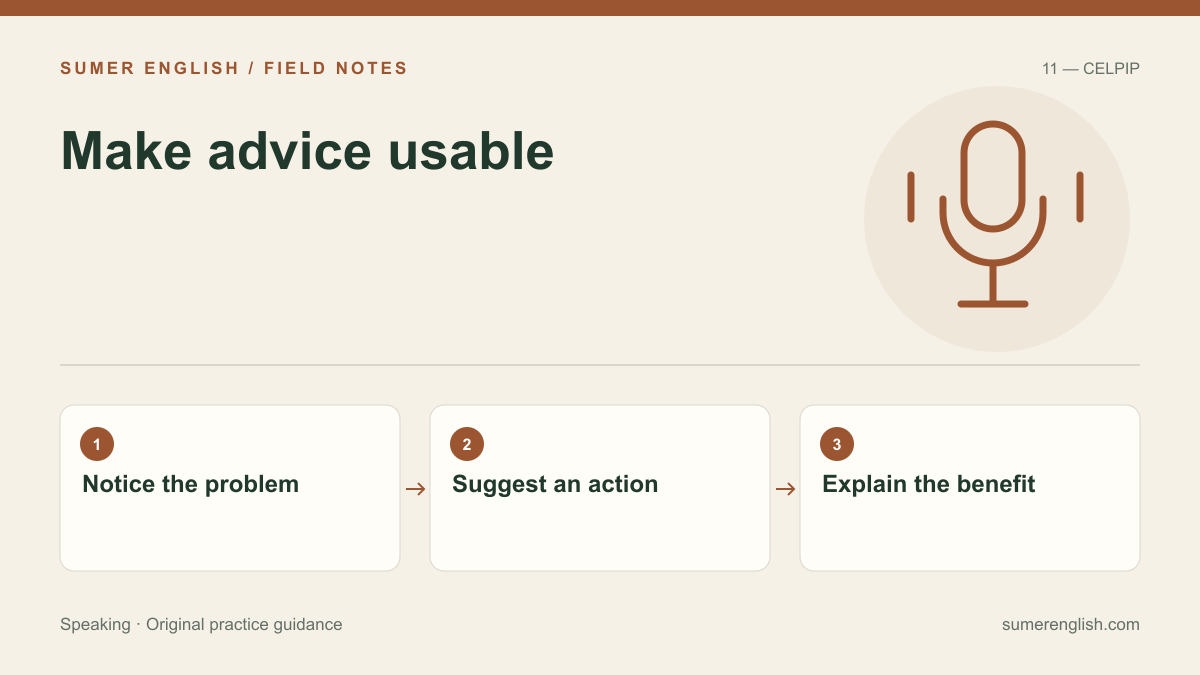
Try building each suggestion around an action and a benefit. What should the person do, and how will it help in the situation described? That gives you something concrete to explain without reaching for impressive vocabulary.
Read the person, not just the topic
A person starting a first office job needs different advice from an experienced worker changing departments. A student with a limited budget needs a different plan from someone who mainly lacks time. Notice those constraints before choosing your suggestions.
During preparation, write two short action words and the reason for each. You do not need a complete script. If you spend the planning time composing every sentence, a forgotten phrase can derail the rest of the response.
An original practice scenario
Your friend is starting a new job next week and worries about remembering everyone’s name and understanding the team’s routine. Give your friend practical advice. This is an independent teaching prompt, not an official test question.
Sam, I would make the first week easier by keeping a small notebook with you. After someone introduces themselves, write down their name and one detail about their role. You do not need to remember the entire office on the first morning, and those notes will help you ask the right person when you need something.
I would also ask your manager which tasks matter most during your first few days. That way, you will not spend hours on something that can wait. If an instruction is unclear, repeat it back in your own words before you start. It is much easier to correct a misunderstanding then than to redo the work later.
Finally, give yourself permission to be new. Be friendly, ask sensible questions and focus on learning the routine. Nobody can absorb every detail immediately.
What to borrow from the example
Borrow the relationship between the ideas, not the exact sentences. The notebook solves the name problem. Asking about priorities solves the routine problem. Repeating an instruction offers a specific action when something is unclear. Each suggestion has a job.
The ending also fits the relationship: this is advice to a friend. It would sound different if the task asked you to address a customer or a supervisor. Tone comes from word choice and directness, not simply from adding a greeting.
Keep the response flexible
If the prompt changes to a friend moving into shared accommodation, the notebook advice is no longer the obvious answer. You might suggest agreeing on chores and discussing quiet hours. Explain the practical benefit of each: fewer assumptions, fewer arguments and a clearer routine.
A useful test is to remove the topic words from your response. If it could be delivered unchanged for almost any problem, it is probably too generic. Add a detail that belongs specifically to this person’s situation.
Review for clarity before accent
Listen to the recording and write the two main suggestions you hear. If you cannot identify them without effort, organise the response more clearly. Then listen for sentences that trail off or contain several restarts. Repair one of those rather than trying to erase every trace of your accent.
This sample is not an official scored response. Timing also depends on delivery, so record it if you want to understand its length, then use the actual prompt’s timer for your own practice. Do not assume a written sample automatically fits the recording window when read at any speed.
A ten-minute drill
Choose a fresh prompt in our Speaking section. Plan two actions and their benefits, record once, and listen once. On the next attempt, keep the structure but change the scenario. You are practising the ability to help a listener—not the ability to perform a memorised speech.
Sources & editorial notes
Official details checked on . Verify changing prices, policies and requirements with the relevant organisation.
Examples and practice advice are original Sumer English material, not official test questions or rated responses. Sumer English is independent of the CELPIP test provider. How we prepare these guides.