You recognise “inconvenience,” “accommodation” and “implementation” when you read them. Then a speaking prompt appears, and the sentence you produce is “It is a good thing for people.” This gap between recognition and use is where vocabulary practice needs to work.
A longer word list will not necessarily close the gap. Try learning language in small combinations that you can retrieve for a real communicative purpose: explain a delay, recommend an option, describe a concern or ask for clarification.
Start with useful combinations
English words often work in familiar partnerships. You make an arrangement, raise a concern, meet a deadline and resolve a problem. Learning the whole combination reduces the number of decisions you must make while speaking or writing.
| Purpose | Useful phrase | Original example |
|---|---|---|
| Explain a problem | cause a delay | The missing document caused a delay in processing the order. |
| Request action | arrange a replacement | Could you arrange a replacement before Friday? |
| Discuss a choice | meet our needs | The smaller room would meet our needs for weekly meetings. |
| Describe a drawback | limited access | Evening workers have limited access to the current service. |
| Suggest a solution | reduce waiting time | A booking system could reduce waiting time. |
These are ordinary phrases. Their value comes from accuracy and relevance. Do not force all five into one answer simply because you studied them today.
Organise by situations you can explain
Build small sets around housing, work, community services, shopping, transport and study. Within each set, include actions and consequences rather than only nouns. “Bus,” “station” and “ticket” name things. “Miss a connection” and “allow extra travel time” help you tell a story or give advice.
For every phrase, write one sentence that makes sense without additional explanation. Then say the sentence aloud. If you cannot pronounce it comfortably or explain its meaning simply, give it more attention before moving on.
Practise retrieval, not just rereading
Close the notebook and look at a situation: a delivery is late, a meeting room is too small, or a neighbour needs help choosing a course. Try to produce two sentences using relevant language. Only then check your notes.
Revisit the phrase later with a different situation. “Arrange a replacement” can apply to a damaged item; “arrange a meeting” has a related verb pattern but a different purpose. These small variations help you learn what the word can actually do.
Upgrade precision before difficulty
Instead of replacing “good” with a fancy synonym, identify what you mean. Is the option affordable, reliable, accessible, convenient or suitable for beginners? Each word makes a different claim. Choose the one supported by your explanation.
Compare “The service is bad” with “The service is unreliable because buses frequently arrive after the scheduled time.” The improvement comes from a clearer meaning, not a dramatic increase in word length.
Keep vocabulary separate from unsupported promises
The official performance standards consider vocabulary alongside other dimensions. There is no responsible way to promise that inserting a particular list will produce a particular score. Language that does not fit the audience or topic can make an otherwise clear answer harder to read.
Use a dictionary to check meaning, grammar and common combinations during study. Pay attention to examples, not just the first translation. Words that share a translation in your first language may not behave the same way in English.
A small weekly routine
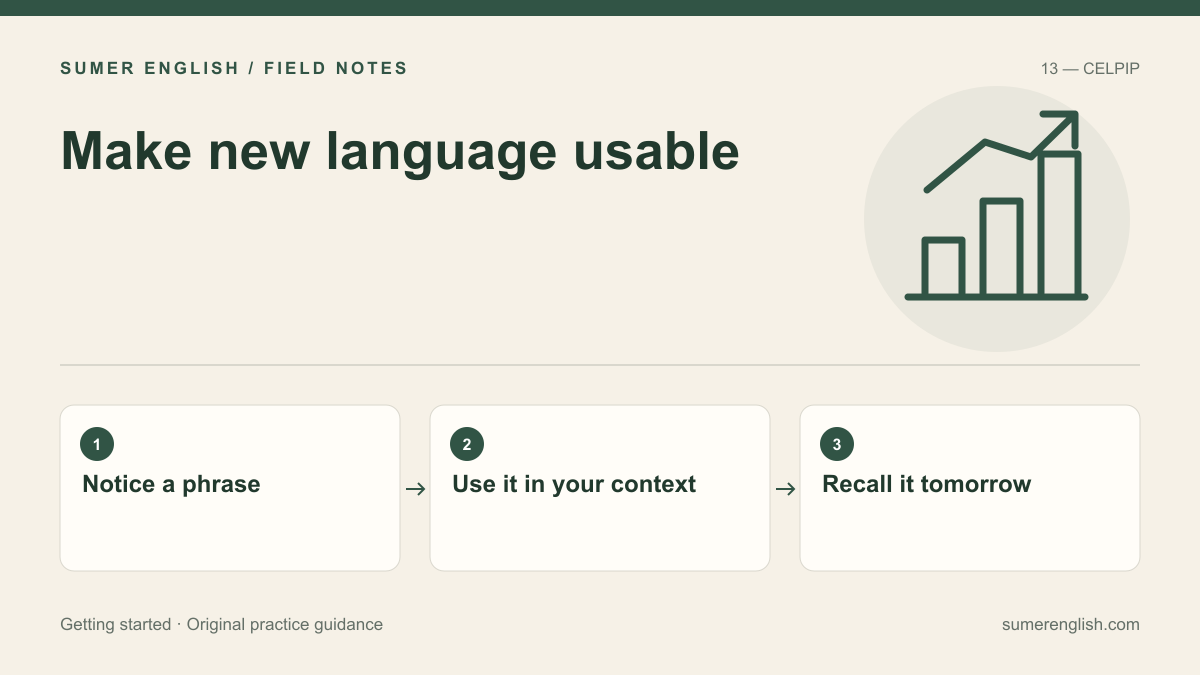
Choose a handful of phrases from actual mistakes or gaps in your practice. Write them, say them, recall them the next day and use them in a new response. Remove phrases you already use comfortably from the active list so the notebook does not become a museum of things you once studied.
Try a new Writing task or Speaking prompt and notice whether the language comes when you need it. That is a better test of vocabulary growth than recognising a page full of highlighted words.
Sources & editorial notes
Official details checked on . Verify changing prices, policies and requirements with the relevant organisation.
Examples and practice advice are original Sumer English material, not official test questions or rated responses. Sumer English is independent of the CELPIP test provider. How we prepare these guides.