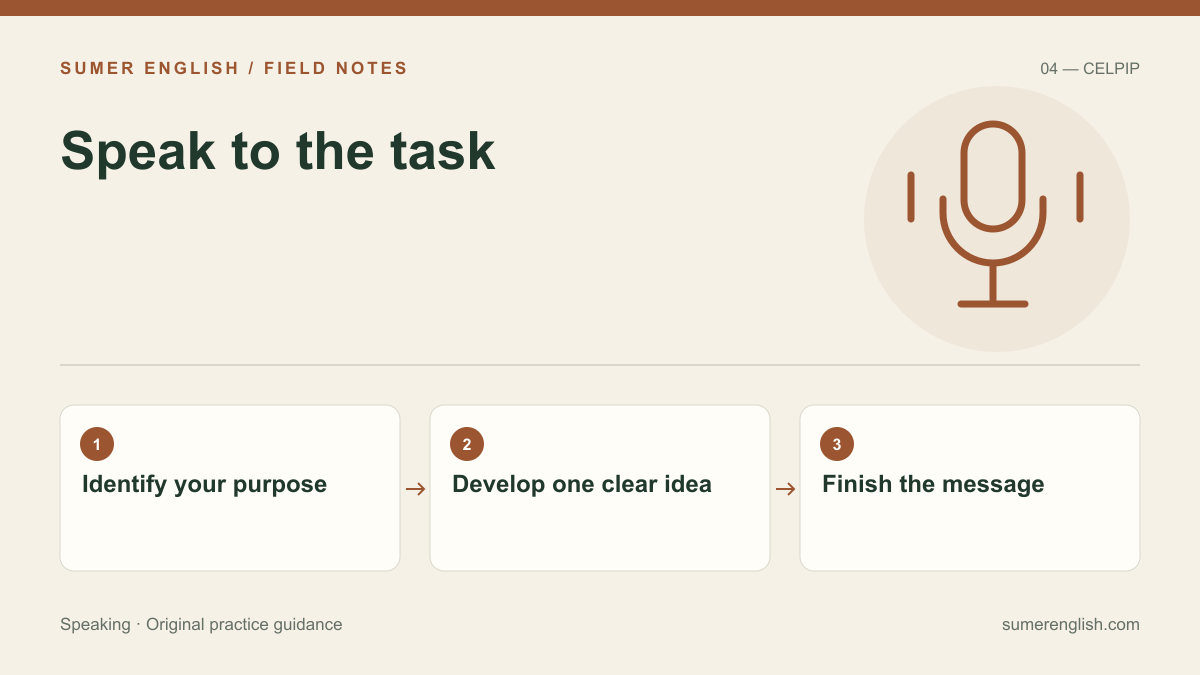
One speaking template cannot do eight different jobs. A good description helps someone picture a scene. Good advice helps someone make a decision. A persuasive answer gives another person a reason to agree. Start by noticing which job the prompt has given you.
The official CELPIP format lists eight Speaking tasks. The guide below explains them in plain language and adds original practice suggestions. Use the preparation and recording times shown on your actual screen; do not assume every task has the same limit.
1. Giving Advice
Speak to the person in the situation, not to an abstract examiner. Recommend something manageable and explain why it fits. If a friend is nervous about a new job, “arrive early” becomes useful when you explain that it leaves time to find the right entrance and settle in. Two developed suggestions are usually easier to follow than a list of six.
2. Talking about a Personal Experience
Give the listener a place, a problem or event, and an outcome. Avoid spending most of the response setting the scene. For practice, choose an ordinary memory: missing a bus, helping a colleague, learning to cook a dish. Ordinary events can support clear storytelling. Keep the time sequence consistent so the listener does not have to reconstruct it.
3. Describing a Scene
Start with the overall setting, then move through a few visible details in a deliberate order. “On the left” and “near the entrance” help connect those details. Describe actions and relationships, not just a list of objects. Do not invent a person’s occupation or emotions when the image does not support them.
4. Making Predictions
Move from what you can see to what may happen next. Give the visual reason for the prediction. “The cyclist may stop because a child is stepping onto the path” is more grounded than a random story about an accident. Words such as “might” and “probably” let you express uncertainty naturally.
5. Comparing and Persuading
Choose the option and compare it using the other person’s priorities. A cheaper apartment is not automatically better if the commute costs more and takes longer. Make the trade-off explicit. In practice, argue for each side of the same choice on separate recordings; this trains flexible reasoning rather than attachment to one prepared opinion.
6. Dealing with a Difficult Situation
Acknowledge the difficulty, communicate your decision and offer a workable next step. The tone matters. “I understand you were counting on me” can soften a refusal, but it still needs a clear explanation. Do not keep apologising until the recording ends without saying what you will do.
7. Expressing Opinions
Give your position early. Develop reasons with specific consequences or examples. If you support longer library hours, explain who would use them and why existing hours create a problem. You are not required to solve the entire public-policy issue in one response. A clear, supported argument is enough to practise.
8. Describing an Unusual Situation
Help someone understand something unfamiliar. Begin with a recognisable reference point, then explain what makes the object or situation unusual. “It looks like a small suitcase, but it has a fold-out seat” is easier to picture than a string of disconnected adjectives. Use shape, position, size and function as needed.
How to review a recording without getting lost
Listen once for the message: would a real listener understand the main point? Listen again for one language issue, such as unfinished sentences or an unclear word ending. Do not try to mark every imperfection. Choose one repair and record a new response to a different prompt.
Our Speaking practice supports recording, playback and self-review. It does not provide official ratings, and Speaking AI scoring is not an available feature in this release. A trusted teacher or language partner can add another perspective when your own recordings all start to sound familiar.
Fluency is not simply speed. Leave the listener enough space to follow your thought. A short pause between ideas is usually less disruptive than racing into a sentence you cannot finish.
Sources & editorial notes
Official details checked on . Verify changing prices, policies and requirements with the relevant organisation.
Examples and practice advice are original Sumer English material, not official test questions or rated responses. Sumer English is independent of the CELPIP test provider. How we prepare these guides.