“There is a man. There is a tree. There is a bicycle. There is a dog.” The sentences may be correct, but the listener still has to assemble the picture. A useful scene description does some of that assembly for them.
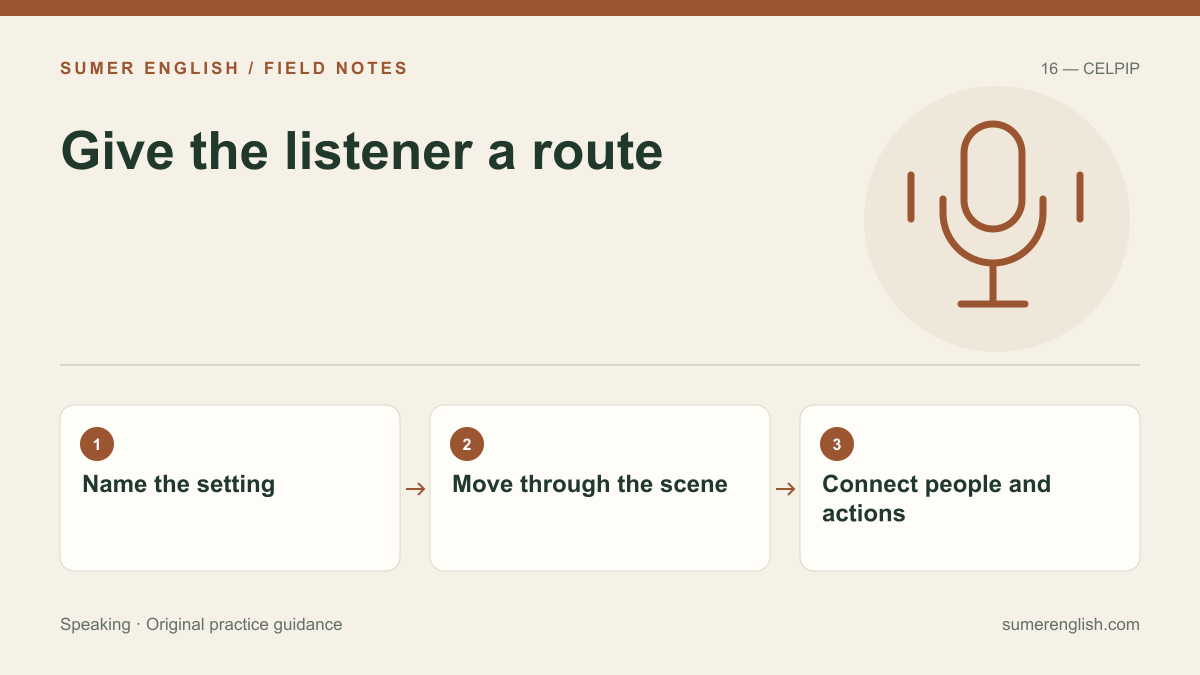
Start with the overall setting, choose a route through it, and describe how the important details relate. You do not need to mention every object to make the scene understandable.
Give the listener an overview
A simple opening such as “This looks like a busy park on a sunny afternoon” creates a frame for the details that follow. Only include what the picture supports. If the time of day or location is uncertain, use cautious language rather than inventing a precise story.
Then choose two or three areas worth describing. You might move from foreground to background, left to right, or from a central activity to the people around it. The exact route matters less than using one consistently.
Connect an object with an action
Compare “There is a bicycle near a bench” with “A cyclist is leaning the bicycle against the bench while another person waits nearby.” The second sentence gives the listener a relationship. Of course, it is appropriate only if the action is actually visible.
Useful language includes position words, action verbs and references that avoid repeating the same noun. “Behind them,” “near the entrance” and “on the opposite side” can help the listener follow your route. Use them accurately; variety is not worth making the location confusing.
A practice scene you can build yourself
Draw a simple park: a bench on the left, a path through the centre, two people playing with a ball on the right and a kiosk in the background. Add a person sitting on the bench and a cyclist on the path. Artistic quality does not matter; the purpose is to practise organising information.
Now describe it without looking at any prepared wording. The drawing gives you several possible routes. Try one from left to right and another that begins with the central path. Which version would be easier for a listener to sketch?
An original sample opening
The picture shows a small park with several people enjoying the outdoor space. On the left, someone is sitting on a bench beside the path. A cyclist is travelling through the centre of the scene, while two people on the right are playing with a ball. Farther back, there is a kiosk near the edge of the park.
This is a short teaching example based on the invented scene above, not a complete timed answer or an officially rated sample. To develop it, add visible details that help distinguish the activities. Do not pad it with information about the people’s lives.
Keep description and prediction separate
Describing what is visible is different from predicting what might happen next. “A child is reaching towards a ball” is an observation. “The child may pick it up” is a prediction. Both can be useful language, but the task determines which one belongs in your response.
When practising predictions, connect them to evidence and acknowledge uncertainty. When practising a description, do not allow a long invented future story to replace the picture itself.
Use the listener test
Record your description and ask someone who has not seen the image to sketch its basic layout. The sketch does not need to match every detail. If the main objects end up in the wrong places, your position language may need work. If everything is present but disconnected, develop the relationships.
You can also do this alone: listen later without looking at the original picture. Try a new image in our Speaking practice section and compare how clearly you guide the listener. Clear organisation makes a description useful; a long inventory merely makes it longer.
Sources & editorial notes
Official details checked on . Verify changing prices, policies and requirements with the relevant organisation.
Examples and practice advice are original Sumer English material, not official test questions or rated responses. Sumer English is independent of the CELPIP test provider. How we prepare these guides.