“Which is easier, CELPIP or IELTS?” sounds like a simple question. It is usually shorthand for something more personal: which test gives me a fairer chance to show the English I already know?
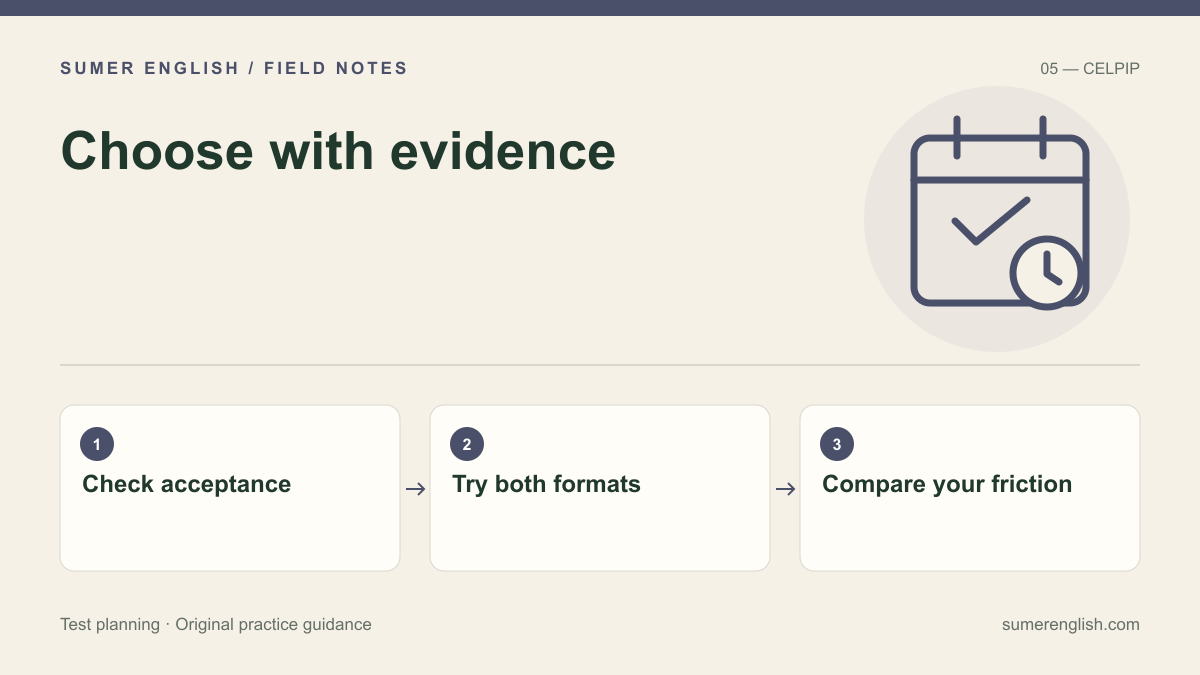
Start with acceptance. The organisation requesting your result decides which test and version it accepts. Do not book IELTS Academic when it requires General Training, or CELPIP-General LS when it requires General. A comfortable format is no help if the result is not accepted for your purpose.
The Speaking experience is a useful starting point
CELPIP Speaking asks you to record responses to on-screen tasks. IELTS Speaking is an interview with an examiner. The official IELTS description divides it into three parts and gives a duration of 11–14 minutes. Check the provider’s arrangements for your chosen test centre.
Neither setup is automatically easier. A microphone can feel less intimidating because nobody is watching your face. It can also feel awkward because you receive no conversational reaction. An examiner offers a human interaction, but some candidates become more self-conscious in that setting.
Try both experiences instead of guessing. Record a response to an unfamiliar prompt without restarting. Then ask a language partner to interview you and ask follow-up questions. Compare how clearly you organised your ideas, not just how comfortable you felt afterwards.
Look at the writing you will actually produce
CELPIP Writing involves an email and a survey response. IELTS General Training involves a letter and an essay. Both require you to respond to a particular task; a strong answer in one format is not a ready-made answer in the other.
If you write work emails regularly, the CELPIP email may feel familiar. That familiarity does not eliminate the need to answer every instruction. If you have practised longer arguments, an essay may feel more natural. Again, try a real sample before deciding.
For each trial, save the timed version and ask three questions: is my position or purpose clear, did I include all necessary details, and can a reader follow the progression? Avoid comparing a polished CELPIP response with an unrevised IELTS first attempt.
Compare practical friction
Availability, travel, accessibility arrangements and deadlines can matter as much as preference. Check actual seats at the location you would use. A nearby test with a suitable date may be more practical than a theoretically perfect format that requires an expensive overnight trip.
Also investigate the exact delivery format being offered. Keyboard comfort, reading on a screen and the way you enter answers can affect your pace. Use official sample materials to see those mechanics rather than relying on an old comparison chart.
A simple decision worksheet
| Question | What to record |
|---|---|
| Is this version accepted? | The receiving organisation’s current requirement |
| Can I get a suitable date? | Location, travel and available result buffer |
| How did Speaking feel? | Where the response became unclear or incomplete |
| How did Writing go? | Task coverage, organisation and editing time |
| What would I need to practise? | Two specific weaknesses in each format |
Do not turn this into an elaborate scoring system. Its purpose is to replace vague impressions with observations. “I prefer CELPIP” is a conclusion; “I finish its email task more consistently, but need microphone practice” is a plan.
Choose, then commit to the task types
Switching tests every time practice goes badly can become another form of avoidance. Once you have checked acceptance and tried both formats, choose the one you can prepare for consistently. Spend your time learning its demands rather than reading another twenty arguments about which exam is easier.
You can explore our independent CELPIP practice platform to try CELPIP-style tasks. For IELTS, begin with the official resources linked below. Sumer English’s IELTS product is not yet available. No comparison here guarantees a score, admission or immigration outcome.
Sources & editorial notes
Official details checked on . Verify changing prices, policies and requirements with the relevant organisation.
- IELTS: General Training format
- IELTS: General Training Speaking
- IELTS: General Training Writing
- CELPIP: official test format
Examples and practice advice are original Sumer English material, not official test questions or rated responses. Sumer English is independent of the CELPIP test provider. How we prepare these guides.