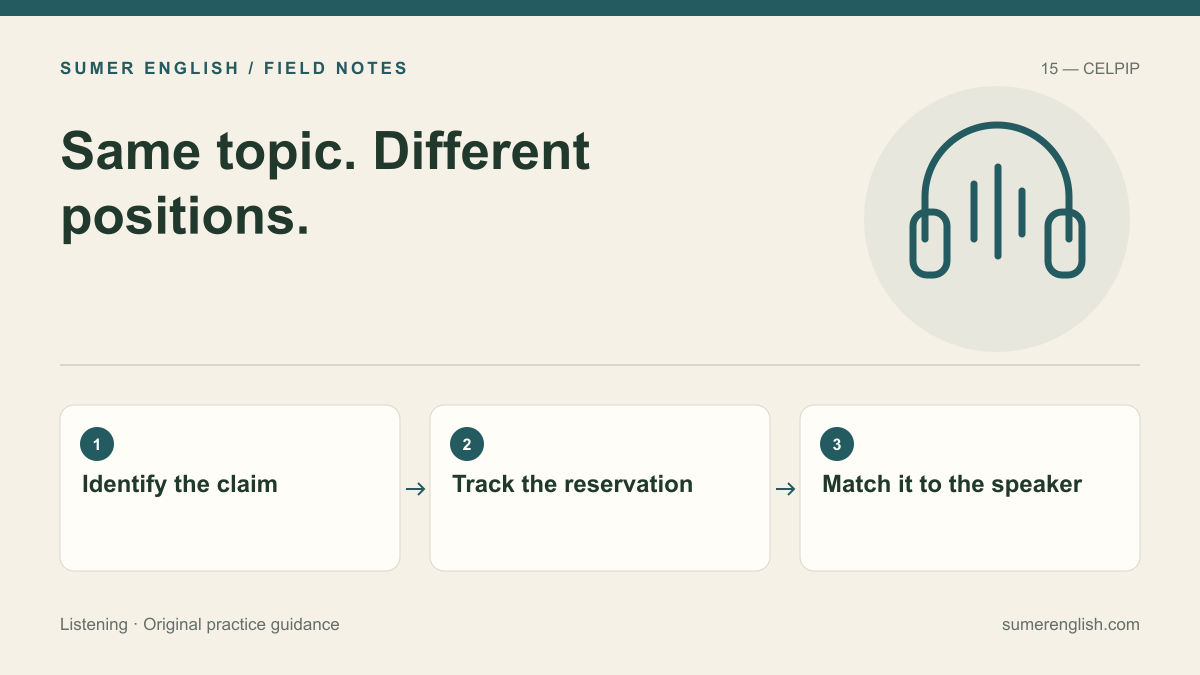
Three speakers can all mention the cost of a project and still hold three different opinions about it. One thinks it is affordable, one wants more evidence, and one would spend the money elsewhere. If your notes contain only “cost,” you have captured the topic and lost the positions.
When practising viewpoint-based listening, record what a person believes about the topic. Then add the reason or reservation that makes their position distinct.
Use a claim-and-condition note
A short note such as “supports / only if trial succeeds” is much more informative than “trial.” It preserves both the direction and the limit of the opinion. Likewise, “opposes now / not against idea” prevents you from treating a concern about timing as total rejection.
Listen for signals that qualify a statement: “in principle,” “provided that,” “for now,” “I would rather,” and “that does not mean.” These are not magic answer words. They are clues about how the surrounding ideas relate.
An original three-speaker exercise
The following invented discussion concerns a proposal to make a downtown street car-free on summer weekends. Read it to practise identifying positions; it is not an audio simulation or an official question.
Priya: I like the idea. The street is already busy with people walking between the market and the park. If deliveries can still get through early in the morning, closing it to ordinary traffic could make the area more pleasant.
Daniel: I would prefer a short trial before we commit to the whole summer. We do not yet know how much traffic would move onto the neighbouring streets. I am not opposed to the proposal, but I want that measured.
Rosa: My concern is access for customers who cannot walk far. I would support the closure if there were a convenient drop-off point nearby. Without that, some people could find the area harder to visit.
What can you reasonably conclude?
Priya supports the idea with a delivery-access condition. Daniel wants evidence from a trial before a longer commitment. Rosa’s support depends on accessible arrival arrangements. None of the three says that every vehicle should be permanently banned from the entire neighbourhood.
If asked who is most concerned about spillover traffic, Daniel is the supported choice. If asked who raises an access issue for some customers, choose Rosa. Priya also mentions access, but for deliveries. The shared word is not enough; the object of the concern matters.
Do not confuse an example with the main claim
A speaker may describe a problem at another location to explain a concern. That example supports the argument; it does not necessarily describe the place currently being discussed. Note whether the person is talking about this proposal, a past experience or a hypothetical outcome.
The same caution applies to reported opinions. “Some shop owners say…” tells you whose claim follows. It does not automatically mean the speaker agrees. Wait for the speaker’s response before assigning a position.
Practise with unfamiliar audio
For a listening drill, ask a partner to read a new discussion once, or use an unfamiliar recording. Give each voice a row. After listening, summarise its position in your own words before looking at answer choices. This forces you to build a meaning rather than search options for remembered phrases.
During review, replay the point where the stance becomes clear if the resource allows it. Check whether you missed vocabulary, a contrast, or the speaker change. Each problem suggests a different next exercise.
A manageable goal for the next test
In your next Listening practice session, try to write one short position statement for each speaker. Do not attempt a transcript. At the end, ask whether you could explain the disagreement to someone who did not hear the recording.
If your explanation reduces everyone to “they talked about traffic,” add the missing positions. Understanding the subject gets you into the conversation. Understanding the relationships lets you follow it.
Sources & editorial notes
Official details checked on . Verify changing prices, policies and requirements with the relevant organisation.
Examples and practice advice are original Sumer English material, not official test questions or rated responses. Sumer English is independent of the CELPIP test provider. How we prepare these guides.